
Cover styles
Solar Tonneau Covers and Usable Power
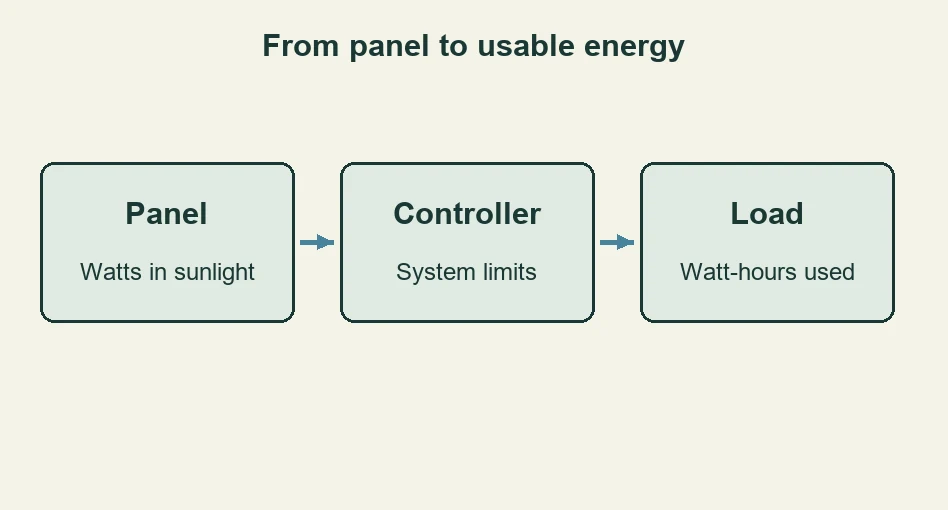
A solar bed cover produces electricity while light reaches the panels. Your load may need power at night, a different voltage or a brief high starting current. Size the job in watt-hours, then check the whole route from bed cover to device.
Start with the device
Multiply average watts by running hours. A device averaging 40 watts over 8 hours uses 320 watt-hours before losses. For a cycling fridge, measure daily consumption or estimate its duty cycle. A peak wattage label by itself cannot tell you the overnight energy use.
Read the solar and storage specifications separately
Worksport lists SOLIS outputs of up to 300, 380 or 480 watts under ideal conditions depending on bed size. It identifies COR or a compatible storage system as a route to storing that energy. A rating in watts is neither daily production nor battery capacity.
| Number | What it answers |
|---|---|
| Collector watts | Rated output under stated conditions. |
| Battery watt-hours | Energy available to serve loads when production is low, subject to usable limits. |
| Output power and surge | Whether the inverter can start and operate the intended device. |
| Input voltage and current | Whether the controller and battery can accept the collector safely. |
Worked example
An overnight fridge changes the battery question
Suppose a camping fridge averages 40 watts over eight hours overnight. That is 320 watt-hours before losses, even if the collector is in complete darkness. Check the battery’s usable capacity, output connector and ability to handle the compressor starting load.
Then park in your usual position and note whether a rack, tree or folded panel shades the collector during the day. Compare energy actually delivered to storage with the overnight demand, including other devices. A higher peak wattage does not fix insufficient night storage or an undersized inverter. Plan alternative charging if several ordinary days cannot replenish the energy you use.
- Write down operating time
- Rated device power without hours of use cannot size overnight storage.
- Match electrical inputs
- The connector shape alone does not establish the controller’s allowed voltage or current.
Choose the limiting condition
Shade from a rack or tree, a folded cover and the season affect solar harvest. Compare an ordinary measured day's energy into the battery with the load's actual demand, rather than multiplying peak power by all daylight hours.
| Situation | What to check |
|---|---|
| Small accessories in camp | Record the connector and daily watt-hours. Allow for shade and keep a backup charging option. |
| A fridge overnight | Choose usable battery capacity for the dark period and confirm compressor surge is supported. |
| A high-draw power tool | Check inverter continuous and surge ratings first. A larger solar array does not help an undersized inverter start the tool. |
Estimate daily energy demand
Verify the vehicle kit
Confirm the cover fits your bed, the electrical interfaces meet both makers' requirements and the cables remain clear through the full opening motion. List which mounting and storage components the quote actually includes.