
Owner guides
Toyota Tundra Tonneau Cover Weight Limits
A Toyota Tundra has a truck payload limit. The cover fitted over its bed has its own structural limits. To decide whether anything can ride on top, first identify the cover by maker, model and application. Tundra fit by itself supplies no cover-surface rating.
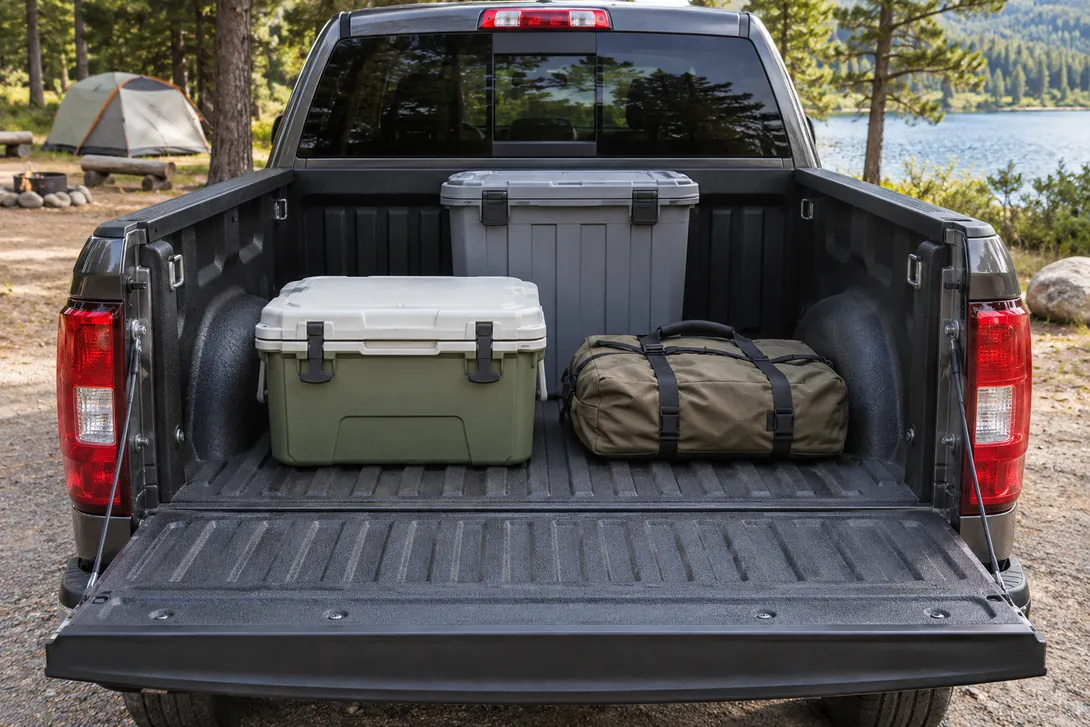
Read the label before the load claim
Toyota's US accessory catalog is a starting point for a factory accessory. For an aftermarket unit, use the cover maker's label and manual. Find the conditions attached to a rating, including where the weight rests, whether it is distributed, how it is tied down and whether the vehicle is moving. If the maker gives no permission for your proposed use, treat that use as unverified.
Separate three questions about weight
Two objects of equal weight can load a panel differently. A small wheel or foot concentrates force over a small contact patch. Cargo on a separately supported rack transfers load along a different route from cargo sitting directly on a lid.
| Question | Which document answers it? |
|---|---|
| Can the truck carry the combined load? | Truck-specific tire and loading information and owner's manual. |
| Can this cover support it? | Exact cover manual with its load distribution and operating conditions. |
| Can this rack or track support it in motion? | Rack, foot and rail documentation for the complete combination. |
Worked example
A cooler with four small feet
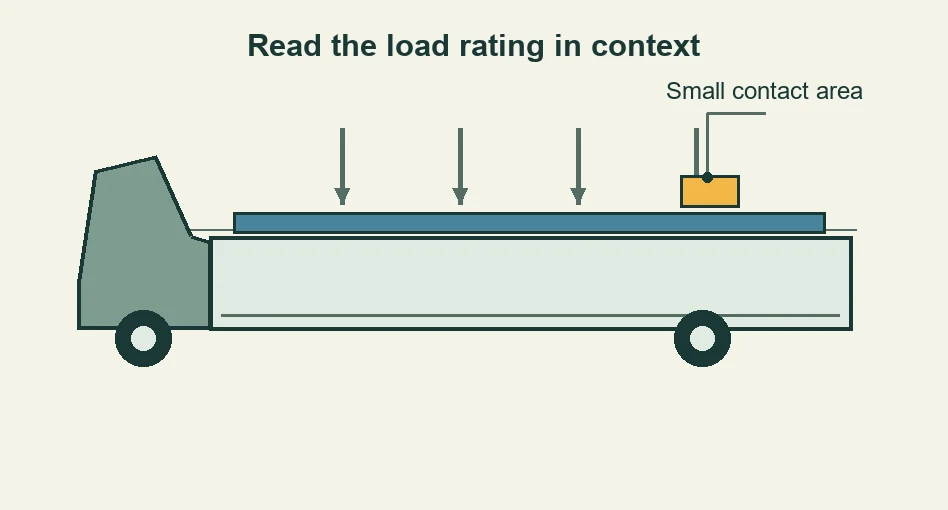
A Tundra owner wants to set a heavy cooler on the hard cover while camping. The cooler stands on four small feet, and most of its weight bears on those small contact areas. Identify the cover by the label under the lid and find the user instructions for that exact model.
Read whether their limit concerns a distributed load, a stationary truck or road travel, and whether point loads are addressed. If it only describes evenly distributed cargo, you have not answered the cooler question. Send the maker the full weight and foot dimensions, or carry it in an approved position inside the bed.
- Define the activity
- Storing lightweight items while parked, carrying equipment at speed and supporting a person are distinct uses.
- Keep the original wording
- Save the conditions attached to a rating along with the number and cover version.
Test the intended use against the documented rating
A manufacturer example such as the DiamondBack HD demonstrates that a purpose-built hauling platform can publish conditions for surface loads. That figure belongs only to the exact product and configuration specified by DiamondBack.
| Situation | What to check |
|---|---|
| A person, wheel or narrow stand | Check for explicit approval for that concentrated load and activity. A uniformly distributed number cannot establish it. |
| Cargo for road travel | Verify moving-load permission, approved tie-down locations and remaining truck payload. Secure the load separately. |
| An item on crossbars | Follow the rating chain from crossbar to foot to cover rail to truck mount. Confirm every interface. |
When the manual gives no number
Send the manufacturer the cover identification, weight, contact footprint, placement and whether the truck will move. Until the maker confirms that use, carry the object in an appropriate rated location. Preserve the written conditions alongside the limit.