
Cover styles
Tonneau Covers for Service Bodies and Utility Beds
A service body has its own center cargo well, flanges and compartment doors. A cover sold by pickup chassis and bed length may have nowhere suitable to mount. Start with the body builder and body model, then measure the opening between compartments.
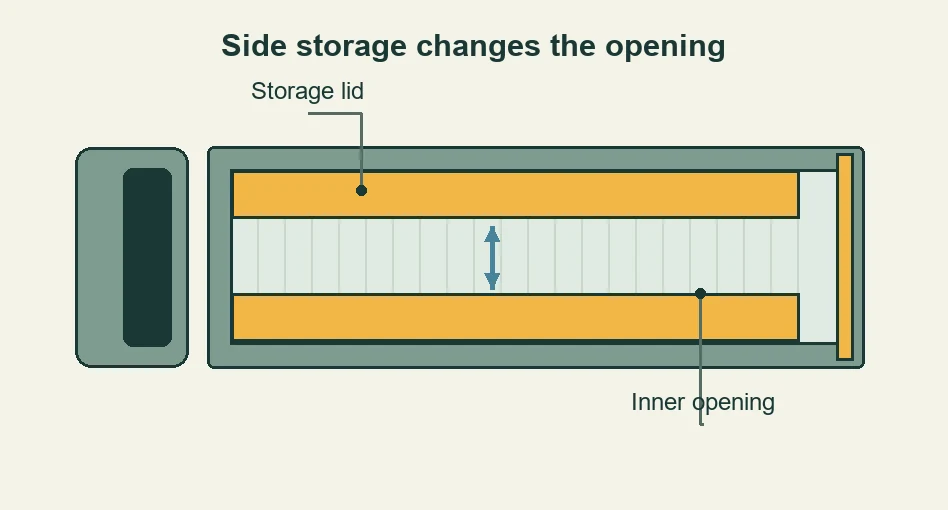
Sketch the center well with the doors open
Take widths at the front, center and rear, both inside lengths and the usable flange width. Mark the heights of door hinges, handles and rack feet. Open every adjoining compartment and the tailgate while parked. A wide-open door can cross a mount that looked clear from above.
Use the upfitter's options
Knapheide literature describes a telescopic sliding roof for service-body cargo space. That is an example of an option offered around the body geometry rather than a stock pickup-tonneau size. Check the literature for the actual body and the approved hardware.
| Information to supply | Reason |
|---|---|
| Body model and serial | Identifies cargo-area geometry and attachment construction. |
| Inner opening and flange | Determines cover size, storage space and permitted mounts. |
| Door and rack travel | Reveals interference when both systems operate. |
| Duty cycle | Defines locking, weather exposure, maintenance intervals and payload needs. |
Worked example
The chassis lookup returns the wrong cover
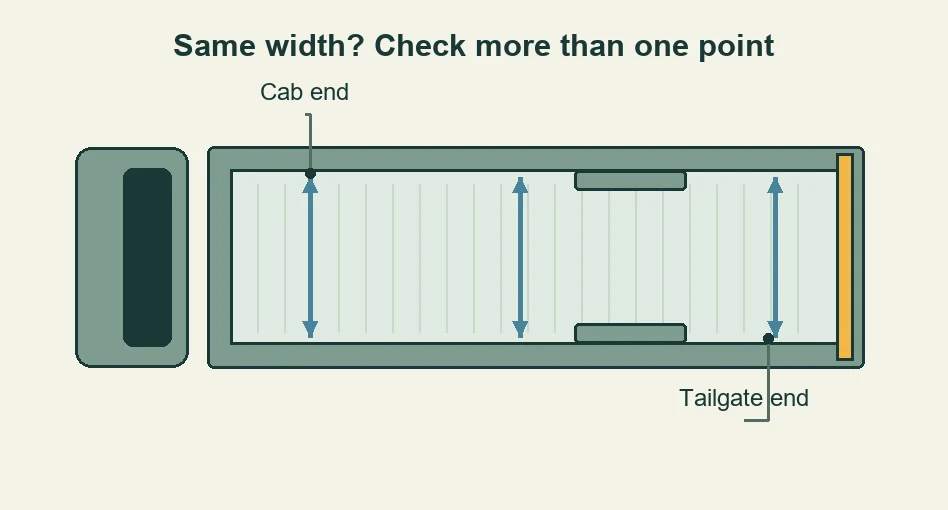
A fleet manager enters a one-ton truck into a pickup-cover fit guide. The cover appears to match the nominal length, but an aftermarket service body has replaced the pickup box. Open the side doors while parked and mark which hinges rise above the inner flange.
Record the body identification, center cargo width at three points and the part of each flange available for an approved mount. Send that drawing to the body builder and ask about its sliding roof or cargo-well options. The useful quote should state whether the doors can operate with the enclosure closed, plus the weight and service requirements of the added system.
- Use the body plate
- A service-body model and serial can identify the attachment structure more directly than the truck VIN.
- Demand a paired-door test
- Two compartments that work separately can still interfere with a roof track when both are opened.
Choose your quoting route
A body ID and dimensioned photos help an upfitter price the right enclosure. Ask who supplies replacement runners, locks or seals and whether installation affects access to equipment.
| Situation | What to check |
|---|---|
| An identified service body | Ask its builder for approved roof or cargo-well options by body model and length. |
| An older body without a readable plate | Photograph the compartment layout, doors, handles and rear step for identification by an upfitter. |
| A custom body with mounted equipment | List access and ventilation requirements for each installed item. Have the designer specify structural and operating limits. |
Accept the finished system by function
Operate every door with the enclosure in its intended positions. Clarify what may ride above the cover and include its weight in the truck's payload calculation. Keep the body and cover identifiers together for service.