
Owner guides
Custom Tonneau Covers for Nonstandard Truck Beds
A custom-cover quote becomes much more useful when the fabricator can see the exact opening and the way you load it. A single length and width omit corner shapes, moving compartments, rail thickness and the place where a latch must engage.
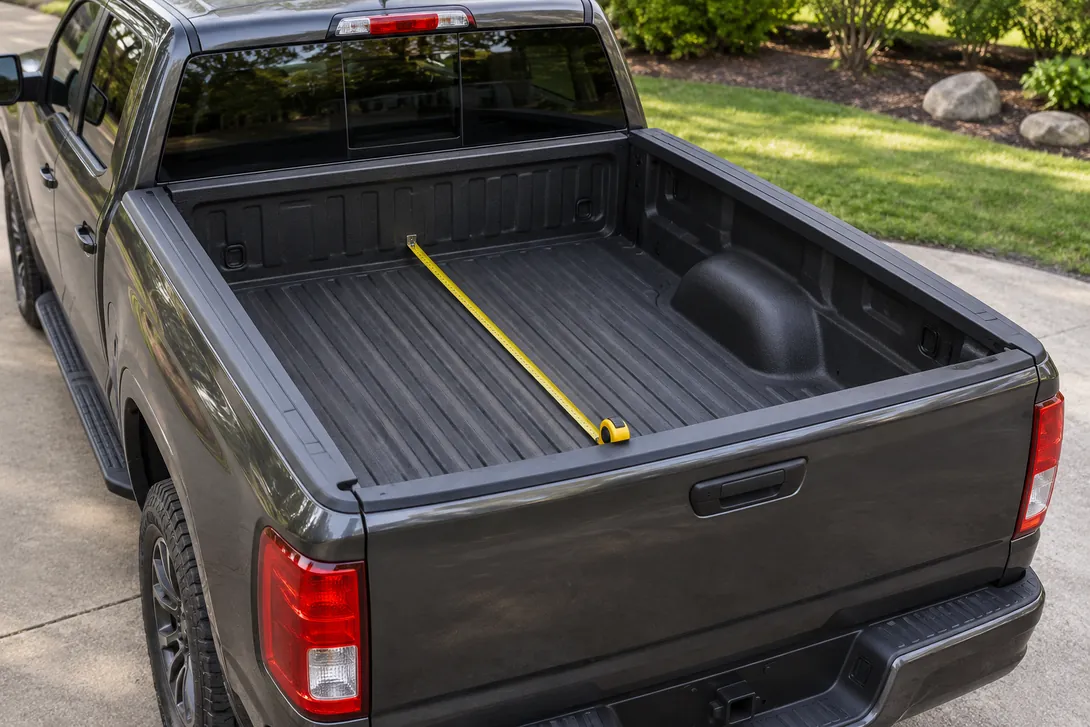
Create a dimensioned outline
Draw the bed from above with the cab at the top. Measure width at three positions, length on both sides, both diagonals, and the height of every bracket or compartment lid that rises above the rail. Label whether each number is taken inside the opening or across the outside of a flange.
Specify the job as well as the dimensions
Provide square-on photos with a ruler visible. Include closed and open views of the tailgate and anything with its own lid. Identify what the owner must be able to reach without opening the entire cover.
| Drawing layer | What belongs on it |
|---|---|
| Mounting | Flange width, material, liner, usable clamp faces and existing holes. |
| Opening | Hinge or roll direction, release access and any part that must remain clear. |
| Water | Seal contact surfaces, drainage route and rear corner transitions. |
Worked example
A square drawing misses the service-door hinge
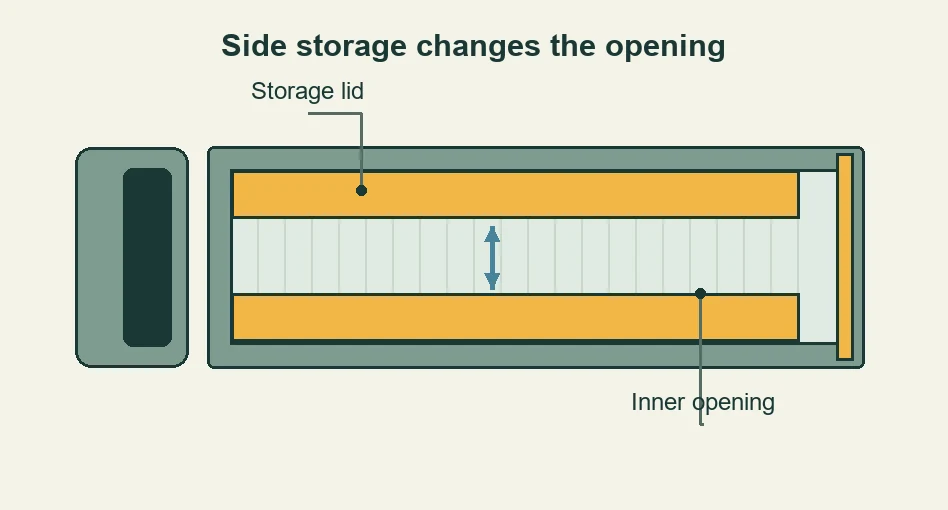
Suppose an older work body measures evenly from side to side at the rear. A single top-view rectangle makes it look like an ordinary short cover will fit. With the truck parked, open the first side compartment and watch its hinge rise above the inner flange.
Measure the hinge at its highest point and mark that distance from the front wall on a side-view drawing. Add photos facing both ends and note which compartments must work with the cover closed. The fabricator can now compare alternate guide positions and price a real solution rather than quoting a generic rectangle and discovering the conflict at delivery.
- Name the reference face
- Label every width as inside opening, outside flange or available clamping face.
- Set an acceptance test
- List which doors must open and which equipment must pass through the completed opening.
Choose the specification that fits the problem
A custom length may solve one mismatch while leaving the biggest obstacle untouched. Make the reason for going custom the first item in your quote request.
| Situation | What to check |
|---|---|
| A front toolbox occupies the bed | Measure the box depth and lid sweep. Compare a commercial toolbox-specific cover before paying for fabrication. |
| An irregular bed or service body | Use the body serial or model number. Include side-compartment travel and inner flange widths in the drawing. |
| A rack interferes with the cover | Send the rack-foot and clamp locations. Obtain written approval for any proposal to share or alter load-carrying hardware. |
Agree on acceptance before fabrication
Ask what the quote includes for seals, finish, mounts, installation, trial fit, maintenance and replacement parts. Plan a parked fit check with the usual cargo. If the cover carries cargo or will be used on the road, get the designer's documented limits and restraint instructions.